NFL Live Betting UK: Maximising In-Play Wagering Markets
 Available in US
Table of Contents
- NFL Live Markets: Evaluating UK Sportsbook In-Play Options
- Timing Your NFL Live Bets: Quarters, Halftime, and Two-Minute Drills
- Mobile In-Play Betting: Why 80% of Live Bets Happen on Phones
- In-Play NFL Strategies That Go Beyond Gut Feeling
- Cash Out on NFL Live Bets: How It Works at UK Bookmakers
- Navigating UK Time Zones for NFL Live Betting
- Frequently Asked Questions
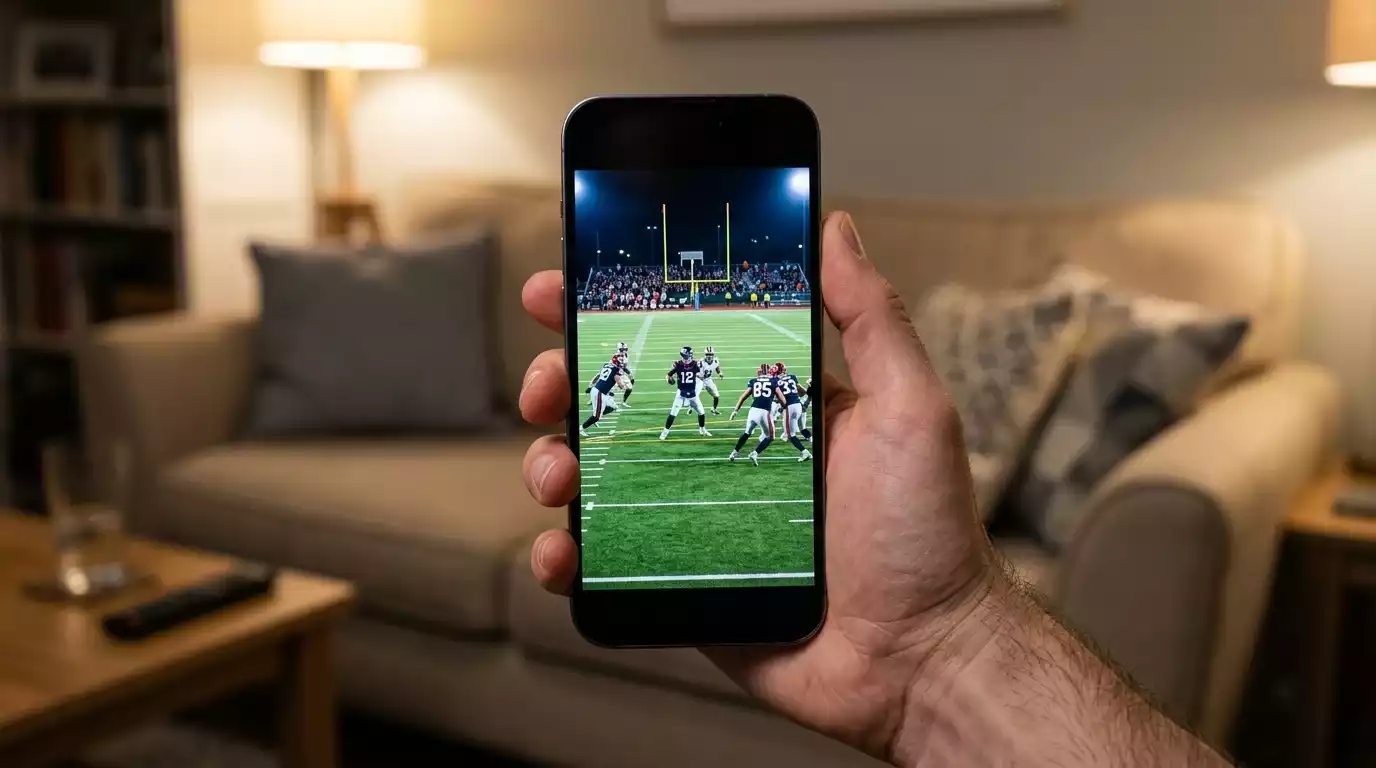
Two seasons ago, I placed a pre-match spread bet on a Thursday night game, watched the opening drive, and immediately wished I’d waited. The starting left tackle was clearly nursing an injury the reports had downgraded to “probable.” The running game was going nowhere. Within ten minutes, the live spread had shifted by four points — and the in-play number was far closer to reality than the line I’d locked in hours earlier.
That experience crystallised something the data had been saying for years: in-play betting isn’t a secondary market anymore. It is the market. Live and in-play wagering now accounts for over 53% of all online sports bets globally, and the growth rate is relentless — projections show it climbing at nearly 15% annually through 2031. For NFL specifically, the sport’s stop-start structure makes it uniquely suited to real-time wagering. Every play stoppage, every commercial break, every injury timeout creates a window where odds recalibrate and bettors can act.
In the UK, the shift toward in-play is even more pronounced. Roughly 80% of all sports bets land on mobile devices, and mobile is the natural habitat for live betting — you’re watching the game, phone in hand, odds refreshing in real time. The infrastructure at UKGC-licensed sportsbooks has caught up to the demand, with dedicated NFL live-betting interfaces, instant bet confirmation, and cash-out options that would have seemed futuristic five years ago.
This guide covers every dimension of NFL in-play betting from a UK perspective: the markets available, the timing windows that matter, the mobile platforms that deliver, and the strategic approaches that separate informed bettors from people clicking buttons on instinct. If you’ve been treating live betting as an afterthought, it’s time to reconsider.
Since timing is critical for in-play markets, finding platforms that offer NFL live streaming and betting simultaneously can give you a significant advantage.
NFL Live Markets: Evaluating UK Sportsbook In-Play Options
Walk into any UKGC-licensed sportsbook’s NFL section during a live game, and you’ll find a market depth that rivals pre-match offerings. That wasn’t always the case. Five years ago, live NFL markets at UK bookmakers were limited to next scoring play and updated match result. Now, the range is comprehensive — and knowing what’s available is the first step toward using it profitably.
The core live markets mirror their pre-match equivalents. Updated point spread, moneyline, and total (over/under) lines recalculate after every significant play. A turnover, a long touchdown, or a field goal changes the live spread within seconds. These three markets attract the heaviest in-play volume because they’re familiar, liquid, and easy to interpret in real time.
Beyond the core, you’ll find quarter-specific and half-specific markets. You can bet on the result of the current quarter, the total points scored in the second half, or which team will lead at the end of any individual period. These markets are useful when you have a read on game flow that differs from the overall result. If a team is losing 14-0 but you believe they’ll dominate the second half after halftime adjustments, the second-half spread lets you express that view without needing to overcome the first-half deficit.
Player-prop markets are increasingly available live at UK sportsbooks, though coverage varies. During primetime games — Sunday Night Football, Monday Night Football, and Thursday Night Football — you can often find live lines on a quarterback’s passing yards, a running back’s rushing total, and anytime touchdown scorer odds that update as the game progresses. During the earlier Sunday afternoon slate, player-prop availability in-play tends to be thinner, particularly at smaller UK operators.
Next-play and drive-result markets are the fastest-moving options. Will the next play be a run or a pass? Will the current drive end in a touchdown, a field goal, a punt, or a turnover? These are essentially micro-bets with rapid settlement — some resolve within 30 seconds of placement. They’re high-frequency and high-risk, and I’d recommend treating them as entertainment rather than a strategic vehicle. The margins are wider, the odds recalculate faster than most humans can process, and the variance is brutal.
GGY from real-event betting across UK sportsbooks reached 570 million pounds in a single quarter during 2025, and NFL’s growing share of that figure reflects both the sport’s rising UK popularity and the expanding in-play market menu. For UK punters, the practical advice is straightforward: stick to the core three markets (spread, moneyline, total) for serious in-play wagering, use quarter and half markets when you have a specific game-flow thesis, and approach next-play markets with a very short leash on your stake size.
Timing Your NFL Live Bets: Quarters, Halftime, and Two-Minute Drills
Not all moments in an NFL game offer the same betting value. The sport’s rhythm creates natural inflection points where the live line is most likely to misprice the true state of play — and those inflection points are where I focus the vast majority of my in-play action.
The first quarter is the highest-variance period. Opening drives are scripted — offensive coordinators prepare their first 15 to 20 plays in advance, meaning early game flow can be misleading. A team that marches 75 yards on their opening possession and scores a touchdown looks dominant, but they were executing a rehearsed sequence, not reacting to the defence in real time. The live spread overreacts to early scores, and I’ve found some of my best in-play value by fading the team that scores first if the opening drive was clearly scripted rather than adaptive.
Halftime is the single most important window for in-play betting. The live markets briefly pause during the break, and when they reopen, the second-half lines reflect what happened in the first half but cannot fully account for the coaching adjustments that take place in the locker room. Some coaches are elite at halftime adjustments — they identify the defensive scheme that caused problems and install counters. Others are rigid. If you track which coaching staffs consistently outperform or underperform their first-half trajectory, you can find edges in the second-half spread that the market hasn’t priced in.
The two-minute drill at the end of each half is a trap for reactive bettors. The pace of play accelerates dramatically — no-huddle offence, sideline routes to stop the clock, tempo designed to prevent defensive substitutions. Live odds swing wildly during these sequences, and the sportsbook’s models struggle to keep up with the speed of events. I’ve learned to avoid placing bets during the final two minutes of either half unless I had a pre-identified trigger. The volatility is too high, the odds update too slowly, and the emotional pull toward action is too strong.
The fourth quarter — specifically the period between the ten-minute mark and the two-minute warning — is where game theory takes over. Trailing teams shift to pass-heavy offence, leading teams run the ball to bleed the clock, and defensive schemes change to protect leads rather than create turnovers. These behavioural shifts are predictable and often not fully reflected in the live total. If a team is protecting a lead with a run-heavy approach and the defence is in a prevent scheme, the live over/under can be inflated relative to the actual pace of play. That’s a spot I target regularly.
Mobile In-Play Betting: Why 80% of Live Bets Happen on Phones
I used to place in-play bets on my laptop, toggling between a live stream and the sportsbook’s desktop site. It felt clunky — by the time I navigated to the right market, confirmed the odds, and clicked “place bet,” the line had already moved. Switching to mobile changed everything. The bet is two taps away from the live odds screen. That speed isn’t a luxury in NFL in-play betting; it’s the minimum viable requirement.
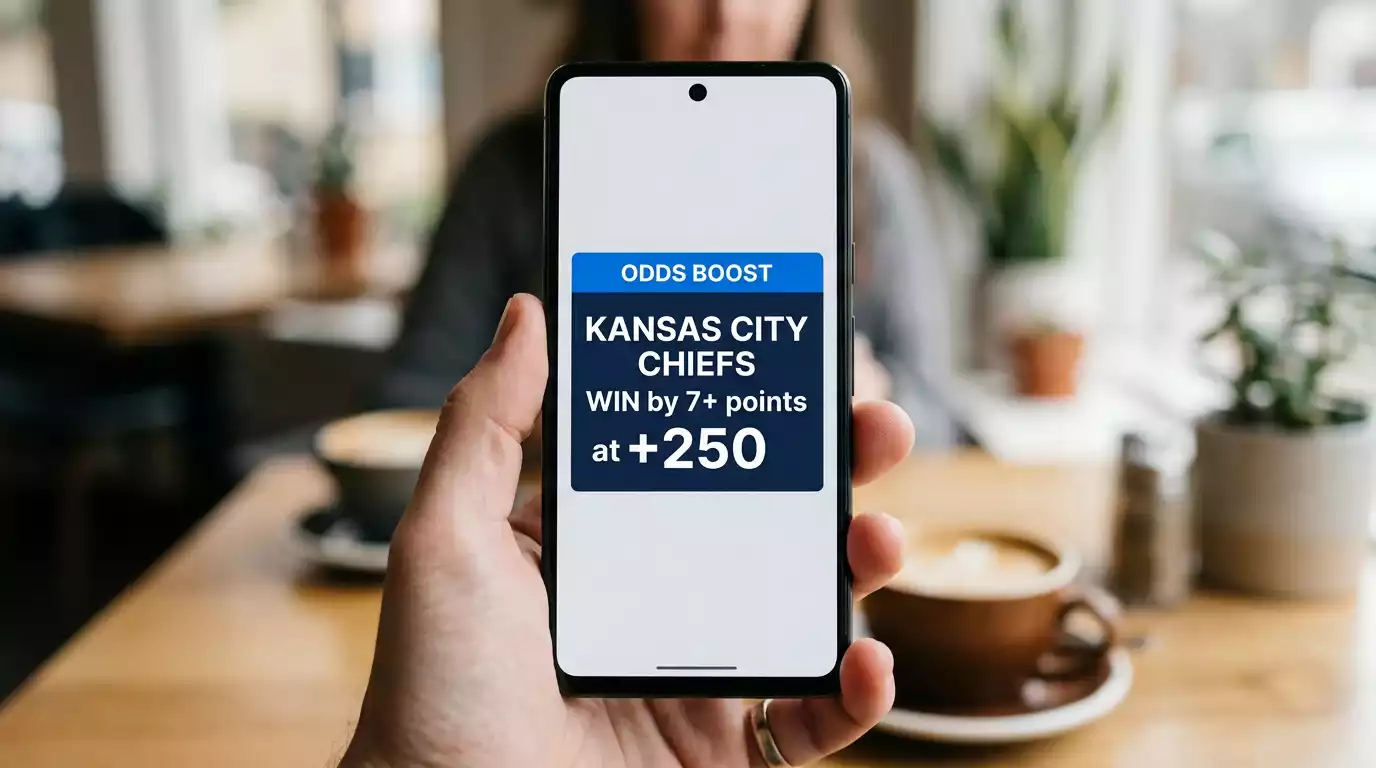
The 80% mobile figure isn’t surprising when you think about how people actually watch NFL in the UK. You’re on the sofa, phone in hand, game on the telly. The sportsbook app is open before kick-off and stays open throughout. Push notifications alert you to odds boosts, cash-out thresholds, and market suspensions. The entire experience is designed around a second-screen workflow, and choosing the right NFL betting app is one of the most consequential decisions a UK bettor makes for in-play wagering.
What separates a good NFL in-play app from a poor one? Three things. First, speed of odds refresh. The best apps update live spreads and totals within two to three seconds of a significant play. The worst lag by ten or more seconds, which means you’re seeing stale prices and submitting bets that get rejected when the odds shift before your confirmation lands. Second, market availability during live play. Some apps suspend markets during active plays and only reopen between snaps — that’s fine, as long as the reopening is instant. Apps that keep markets suspended for 15 to 20 seconds between plays cost you windows of opportunity. Third, bet confirmation speed. A one-tap confirmation with odds-movement protection (the app tells you if the odds shifted and lets you accept or decline) is the standard you should demand.
One practical note for UK punters betting NFL in-play on mobile: battery life and data connectivity matter more than you’d think. NFL games run three-plus hours, and a sportsbook app constantly refreshing live odds is a significant battery drain. If you’re watching at a pub or a mate’s house, bring a charger. And if you’re relying on mobile data rather than Wi-Fi, ensure your signal is strong — a dropped connection during the two-minute drill when you’re trying to cash out is an experience you only need once to learn from.
Stay ahead of the game by using our recommended NFL sports betting platform for real-time updates and fast execution.
In-Play NFL Strategies That Go Beyond Gut Feeling
There’s a version of in-play betting that’s purely reactive — you see a big play, the odds shift, and you jump on whatever feels right. I did that for my first two seasons of live betting and lost steadily. The turning point was building a pre-game framework for in-play decisions, so that by kick-off I already knew what I was looking for and under what conditions I’d act.
The framework starts with identifying a pre-game thesis and a trigger. Before the game, I form a view — say, “I think the underdog’s defence will hold up in the first half, but they’ll fade in the second.” The trigger is the condition that validates or invalidates that view: “If the underdog is within seven points at halftime, I’ll bet the favourite’s second-half spread.” Without a trigger, you’re just reacting to score changes, which is the fast lane to emotional betting.
The second strategic layer is understanding how NFL game flow creates systematic biases in live odds. When a team falls behind by two touchdowns (14 points), the live model assumes they’ll need to throw more to catch up — and they usually do. Pass-heavy offences move faster, create more possessions, and increase total scoring. That means the live total (over/under) rises. But here’s the nuance: pass-heavy comeback attempts also increase turnover risk, which can abruptly end scoring drives. If the trailing team’s quarterback is turnover-prone, the live total may be overinflated because the model expects volume but doesn’t fully discount the interception risk. That’s a spot where the under has hidden value.
Christian Cipollini, a trading manager at BetMGM, has spoken about how in the biggest games the book benefits when scoring stays low and touchdowns are scarce — an acknowledgment that public bettors skew toward overs and high-profile touchdown scorers. That public bias inflates live overs and touchdown props in marquee games, creating an edge for bettors willing to take the less popular side.
A third approach is using live betting to hedge pre-match positions. If you backed the favourite at -6.5 pre-match and they’re up 17-0 at halftime, you can bet the underdog on the live spread to lock in profit regardless of the outcome. The maths are straightforward: your pre-match bet is now heavily in your favour, so the live underdog price is generous. A well-timed hedge guarantees a return on both bets combined, trading maximum upside for certainty. I use this approach roughly once every two or three weeks during the season, and it’s been a meaningful contributor to bankroll stability.
The NFL’s average viewership of 18.7 million per game in 2025 means that live markets are more liquid than ever — which, counterintuitively, makes them harder to exploit. More eyeballs means more informed bettors, which means lines adjust faster and inefficiencies close sooner. Speed and preparation are the remaining edges. Have your thesis before kick-off, define your triggers, and execute without hesitation when the conditions are met. Anything else is gambling against the algorithm.
Cash Out on NFL Live Bets: How It Works at UK Bookmakers
Cash out is the feature that turns live betting from a one-shot commitment into a dynamic position you can manage. I resisted using it for years, viewing it as the sportsbook’s way of buying back winning bets at a discount. I wasn’t wrong — the cash-out price always includes a margin that favours the operator — but I was missing the bigger picture. Used strategically, cash out is a risk-management tool that protects your bankroll in spots where the expected value of holding is uncertain.
The mechanics are simple. At any point during a live game, your sportsbook offers you a cash-out value based on the current state of play. If your bet is winning, the cash-out figure will be less than the potential full payout but more than your original stake. If your bet is losing, the cash-out figure will be less than your original stake but more than zero. You can accept the offer (closing your bet immediately) or reject it and let the wager ride to settlement.
Most UK sportsbooks now offer partial cash out as well. Instead of closing your entire bet, you can cash out a percentage — say, 50% — and leave the remaining half active. This is the approach I use most often. If my pre-match bet is sitting comfortably in the fourth quarter but the game is tightening, I’ll cash out half to guarantee some profit and let the other half run. It reduces the sting of a late-game collapse without sacrificing all the upside.
Auto cash out is the third variant, available at several UK operators. You set a cash-out target in advance — “cash out automatically if the value reaches thirty-five pounds” — and the sportsbook executes when that threshold is hit. It’s useful for games you can’t watch in real time, particularly the Monday Night Football fixtures that kick off after midnight UK time. Set the auto cash-out threshold before bed, and the system manages the exit while you sleep.
The strategic question is always the same: is the cash-out offer fair? The operator’s built-in margin means the offered value is lower than the “true” value of your bet based on the live odds. As a rough guide, the cash-out discount is typically 5% to 10% of the theoretical fair value. If you’re cashing out because you believe the game is genuinely about to turn against you, that 5% to 10% haircut is a reasonable insurance premium. If you’re cashing out purely because of nerves, you’re giving away expected value for emotional comfort — which, over time, is a losing trade.
Navigating UK Time Zones for NFL Live Betting
Here’s the uncomfortable truth about NFL live betting from the UK: most of it happens when you should be asleep. The main Sunday afternoon slate kicks off at 18:00 GMT (17:00 during BST), which is perfectly civilised. But Sunday Night Football starts at 01:20 GMT, Monday Night Football at 01:15 GMT, and Thursday Night Football at 01:20 GMT. If you’re betting in-play on those games, you’re up past 4 a.m. on a work night.
I’ve done that more times than I care to admit, and the quality of my decision-making after midnight is measurably worse than before it. Fatigue erodes discipline. You chase losses, ignore triggers you set pre-game, and place bets you wouldn’t touch at 7 p.m. If you’re going to bet late-night NFL games in-play, set a hard stake limit before kick-off and respect it. Better yet, use auto cash-out thresholds and predetermined bet sizes so that the decisions are made while you’re still sharp.
The UK’s 13 million NFL fans have built a culture around these late-night games — watch parties, group chats, and dedicated communities that make staying up feel normal. But “normal” doesn’t mean “optimal for betting.” I now limit my in-play action on late-night games to one pre-identified bet with a clear trigger. If the trigger doesn’t fire by halftime, I’m done. That single rule has done more for my long-term profitability than any analytical edge I’ve ever found.
The flip side is the London games. When the NFL plays at Tottenham Hotspur Stadium or Wembley, kick-off is at 14:30 BST — a perfectly reasonable Sunday afternoon. These are the only NFL games where UK bettors have the timezone advantage. You’re alert, focused, and watching in real time while American bettors on the West Coast are waking up at 6:30 a.m. The London games are prime in-play territory for UK punters, and I treat them with extra preparation and larger allocations than I would a standard 1 a.m. fixture.
One scheduling detail worth noting: the clock change between GMT and BST shifts NFL kick-off times by one hour for UK viewers. The transition happens in late October (clocks go back) and late March (clocks go forward). Since the NFL season runs from September to February, most of the regular season falls during GMT, meaning the late-night games feel even later than they do in September when BST is still active. Mark the clock change on your calendar and adjust your in-play routine accordingly.
Frequently Asked Questions
What NFL in-play markets can I bet on in the UK?
UK sportsbooks offer a comprehensive range of NFL live markets including updated point spread, moneyline, and over/under totals. You will also find quarter and half-specific results, next scoring play, drive outcome, and — during primetime games — live player props such as passing yards and anytime touchdown scorer. Market depth varies by operator and by the profile of the game being played.
Is cash out available on NFL live bets?
Yes, most UKGC-licensed sportsbooks offer cash out on NFL in-play bets. Full cash out closes your bet immediately at the current offered value. Partial cash out lets you secure a portion of your profit while leaving the remainder active. Some operators also offer auto cash out, where the bet settles automatically once a value threshold you have set in advance is reached.
Why are NFL games played late at night in UK time?
NFL games are scheduled around the American broadcast market. The main Sunday afternoon slate begins at 1 p.m. Eastern Time in the US, which translates to 18:00 GMT. Primetime games — Sunday Night Football, Monday Night Football, and Thursday Night Football — kick off at 8:15 or 8:20 p.m. Eastern, meaning 01:15 to 01:20 GMT for UK viewers. The London International Series games are the exception, with kick-offs typically at 14:30 BST.
Which UK sportsbooks offer the best NFL live betting experience?
The quality of the NFL in-play experience at UK sportsbooks depends on three factors: speed of odds refresh, breadth of live markets, and reliability of cash-out functionality. Rather than naming a single operator, look for sportsbooks that update live NFL odds within two to three seconds of a play, offer quarter-level and player-prop markets during live games, and provide partial cash out with minimal lag. Testing during a regular-season game before committing larger stakes is always worthwhile.
Written by the editors at Betting nfl Games Online.