NFL Betting Odds: Decoding UK Sportsbook Lines
 Available in US
Table of Contents
- Fractional NFL Odds: Comparing UK Bookmaker Formats
- Decimal Odds: A Cleaner Way to Calculate NFL Payouts
- American Odds: Reading the Format Used by US Sportsbooks
- Converting Between All Three NFL Odds Formats
- Implied Probability: What NFL Odds Actually Tell You
- What Drives NFL Odds Movement at UK Sportsbooks
- Comparing NFL Odds Across UK Bookmakers
- Frequently Asked Questions
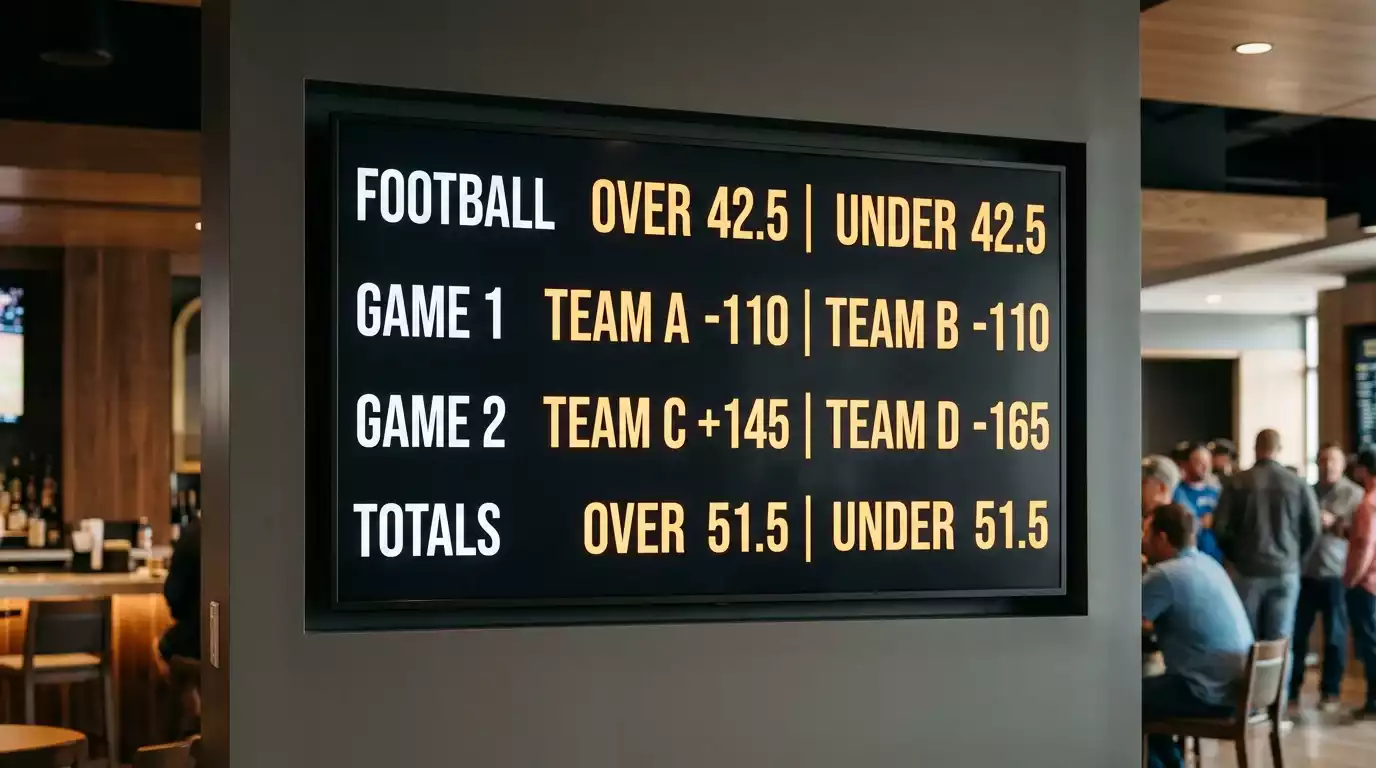
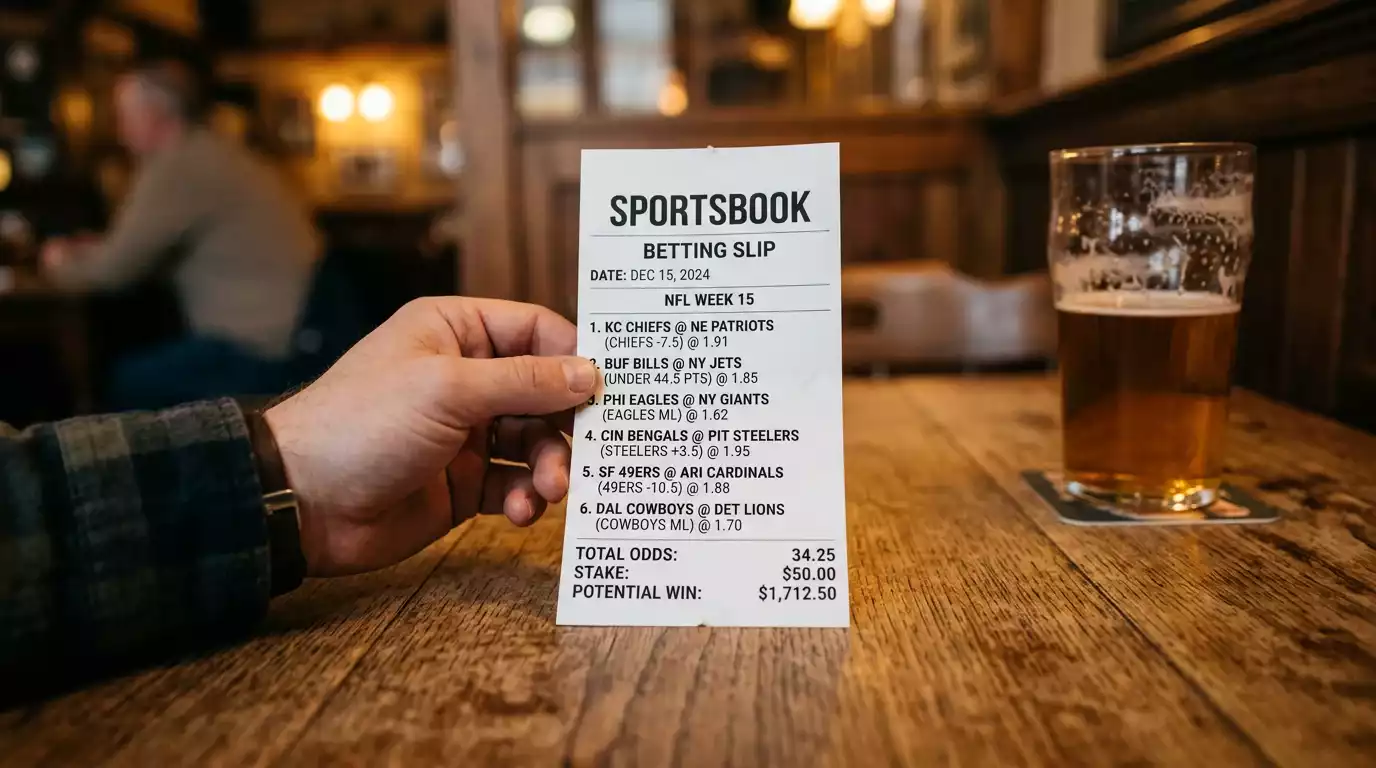
The moment that convinced me to write this guide happened in a pub. A friend had screenshotted a bet from an American sports betting account — Kansas City Chiefs at -150 on the moneyline — and asked me what it meant. He’s been betting on Premier League matches for a decade. He understands odds instinctively. But minus-one-fifty looked like gibberish to him, because he’d never encountered American odds format in his life.
That disconnect matters more now than it ever has. The UK’s online sports betting market generated $7.37 billion in revenue in 2024 alone, and NFL wagering is a growing segment within it. About 10% of the UK population actively bets on sports online, and a rising number of those bettors are engaging with American football — a sport whose native odds format is completely different from what UK sportsbooks display by default.
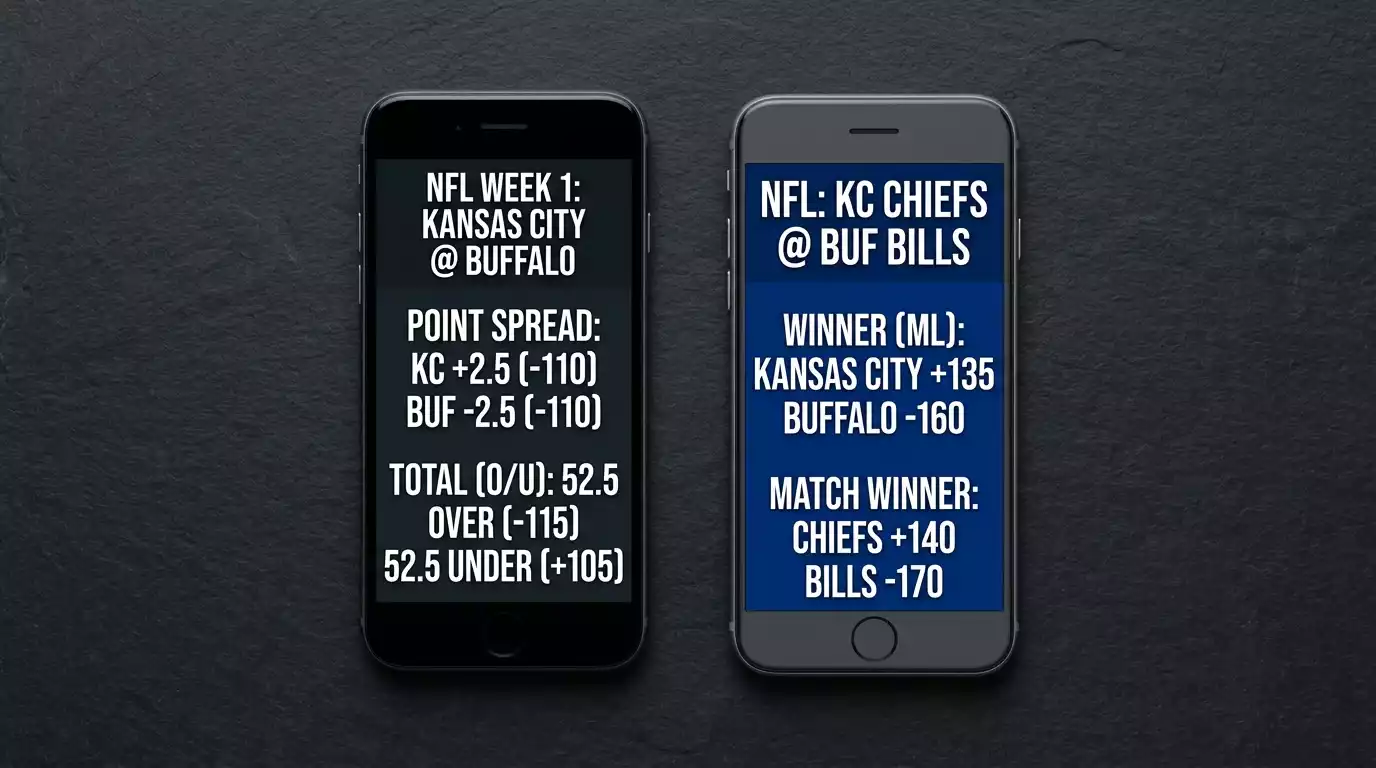
UK sportsbooks present NFL odds in fractional format (5/1, 11/4, 10/11) as the standard, with decimal (6.00, 3.75, 1.91) available as an alternative in your account settings. American odds (-150, +200, -110) appear on US-focused platforms, in American media, and increasingly on UK sportsbook pages that offer all three formats side by side. If you’re serious about NFL betting — and especially if you follow American tipsters, consume US sports media, or compare lines across international platforms — you need fluency in all three.
This guide builds that fluency from the ground up. Each format gets its own section with worked examples using real NFL scenarios. I’ll show you how to convert between them, how to extract the implied probability hidden inside every price, what drives NFL odds to move, and how to compare odds across UK bookmakers to find the best value. By the end, a line like -110 or 2.75 or 7/4 will all tell you the same story — and you’ll read it instantly.
To fully grasp how these odds translate to the field, you should also understand how NFL point spread betting in the UK works for different divisional matchups.
Fractional NFL Odds: Comparing UK Bookmaker Formats
If you grew up betting at a high-street bookmaker or placing weekend accumulators, fractional odds are second nature. They’ve been the default format in British gambling for centuries, and they remain the standard display at every major UK sportsbook. For NFL markets, they work identically to the way they work on Premier League or horse racing — the maths doesn’t change because the sport does.
Fractional odds express profit relative to stake. If the Philadelphia Eagles are listed at 5/1 to win the Super Bowl, a one-pound stake returns five pounds of profit plus your original pound — six pounds total. If the Kansas City Chiefs are 2/1 favourites in their division, one pound returns two pounds profit plus your stake — three pounds total. The first number is your potential profit; the second is the unit you stake.
Where fractional odds get less intuitive is at shorter prices. A moneyline favourite priced at 4/7 means you stake seven pounds to win four — total return of eleven pounds. At 1/3, you stake three to win one. These “odds-on” prices (where the first number is smaller than the second) are common in NFL moneyline markets for heavy favourites, and they’re the prices that trip up bettors who are used to seeing the first number bigger than the second.
The most common fractional price you’ll see on NFL spread bets is 10/11. This is the standard “vig line” — a stake of eleven pounds wins ten, returning twenty-one pounds total. Both sides of a spread are typically priced at 10/11, which gives the sportsbook a built-in margin of about 4.5%. Some operators offer 5/6 (stake six, win five) as an alternative, which carries a slightly wider margin but occasionally appears when the sportsbook wants to attract action to one side.
William Hill dominates the UK sports betting PPC market with nearly 38% of click-through share, and their NFL pages display fractional odds by default — as do bet365, Paddy Power, and virtually every other major UK operator. You can switch to decimal in your account settings, and I’d encourage you to try it for NFL. But if fractional is what you know, the key numbers for NFL are simple: 10/11 for standard spread and total bets, evens (1/1) for true coin-flip propositions, and anything from 2/1 to 50/1 for futures and outright markets depending on the team’s perceived chances.
Decimal Odds: A Cleaner Way to Calculate NFL Payouts
I switched to decimal odds for my NFL betting three seasons ago, and I haven’t looked back. The reason is pure arithmetic efficiency — decimal odds give you the total return in one multiplication, with no mental gymnastics required. Stake times price equals total payout. That’s it.
If the Buffalo Bills are 1.91 on the spread, a ten-pound bet returns 19.10 — your ten-pound stake plus 9.10 profit. If the Detroit Lions are 3.50 on the moneyline as underdogs, a ten-pound bet returns 35 pounds. If a longshot Super Bowl future is priced at 26.00, ten pounds returns 260. The decimal number is the multiplier, and it always includes your original stake in the return.
The format is standard across continental Europe, widely used in Australia, and increasingly popular in the UK — particularly among younger bettors and those who bet across multiple sports. For NFL specifically, decimal odds have a practical advantage: when you’re comparing prices across three or four sportsbooks, the decimal number lets you see which is highest in a glance. Is 1.95 better than 1.91? Obviously. Is 10/11 better than 19/20? You need a moment to think about it. When you’re line-shopping under time pressure — especially during in-play betting — that moment matters.
The relationship between decimal odds and the sportsbook’s margin is also more transparent. On a standard NFL spread, both sides are priced at 1.91 in decimal. If you add the implied probabilities (1 divided by 1.91 = 52.36% per side), the total is 104.72% — the 4.72% above 100% is the sportsbook’s built-in margin, known as the overround. At 1.95 per side, the overround drops to 2.56%. The lower the overround, the better the value for the bettor. Decimal odds make this calculation instant.
One thing to watch: decimal odds below 2.00 indicate an odds-on selection (equivalent to a fractional price where the first number is smaller than the second). A price of 1.50 means you’re risking a pound to make fifty pence profit. At 1.10, you’re risking a pound for ten pence. These short-priced NFL favourites on the moneyline look deceptively safe in decimal format — the number is close to 1.00, which feels like “almost certain.” It isn’t. Even a 1.10 favourite (implied probability 90.9%) loses roughly one game in eleven. Decimal odds make the payout clear, but they can obscure the risk if you equate a low number with a sure thing.
American Odds: Reading the Format Used by US Sportsbooks
American odds are the format you’ll encounter on every US sportsbook, in every American sports podcast, and in most NFL betting content produced stateside. If you consume any American media about the NFL — and most serious UK bettors do — you need to read this format as fluently as you read fractional.
The format uses a positive or negative number anchored to a base of 100. A negative number (-150, -200, -110) tells you how much you must stake to win 100 units. At -150, you stake 150 pounds to win 100 — total return of 250. A positive number (+200, +350, +110) tells you how much you win on a 100-unit stake. At +200, a 100-pound bet wins 200 — total return of 300.
The standard NFL spread price in American format is -110 on each side. Stake 110 to win 100. That’s the equivalent of 10/11 fractional or 1.91 decimal — the same number, three different costumes. When you see a line listed as “Chiefs -3 (-110)” in American media, the -3 is the spread and the -110 is the price. UK sportsbooks would display the same bet as “Chiefs -3 (10/11)” or “Chiefs -3 @ 1.91.”
American odds become less intuitive at extreme prices. A heavy favourite at -500 means staking 500 to win 100 — a ratio that’s immediately clear in decimal (1.20) but takes a moment in American format. A massive underdog at +2500 means a 100-pound stake wins 2,500 — again, clearer in decimal (26.00) for quick mental processing. The American format is designed for a market where the base unit is 100, and it works well in that context. For UK bettors accustomed to thinking in terms of profit-per-pound or total-return-per-pound, it requires translation.
The practical reason to learn American odds is cross-platform analysis. The sharpest NFL line-movement data, the most detailed injury-impact analysis, and the best handicapping content all originate in the US and use American format. If you can’t read -130 or +180 at a glance, you’re locked out of the most valuable information ecosystem in NFL betting. Spend an afternoon converting a dozen American odds to fractional and decimal, and the format becomes intuitive. It’s a one-time investment that pays dividends every week of the season.
Converting Between All Three NFL Odds Formats
You don’t need to memorise formulas. You need to understand the logic, run through it a few times, and then let it become automatic. Here’s every conversion you’ll ever need for NFL odds, with worked examples.
Fractional to decimal: divide the first number by the second, then add 1. If the odds are 5/2, the calculation is 5 divided by 2 = 2.5, plus 1 = 3.50 decimal. If the odds are 10/11, it’s 10 divided by 11 = 0.909, plus 1 = 1.91. The “+1” accounts for your returned stake, which decimal odds include but fractional odds don’t.
Decimal to fractional: subtract 1, then express as a fraction. If the decimal is 3.50, subtract 1 = 2.50, which is 5/2 as a fraction. If the decimal is 1.91, subtract 1 = 0.91, which is approximately 10/11. Some conversions produce awkward fractions — 2.25 becomes 5/4, which is clean, but 2.15 becomes 23/20, which UK sportsbooks would typically round to the nearest standard fraction like 11/10 or 5/4.
American to decimal: for negative American odds, divide 100 by the absolute value, then add 1. At -150: 100 divided by 150 = 0.667, plus 1 = 1.67 decimal. For positive American odds, divide the number by 100, then add 1. At +200: 200 divided by 100 = 2, plus 1 = 3.00 decimal.
Decimal to American: if the decimal is 2.00 or higher, subtract 1 and multiply by 100 to get the positive American number. At 3.50: (3.50 – 1) x 100 = +250. If the decimal is below 2.00, divide 100 by (decimal minus 1) and make it negative. At 1.67: 100 divided by 0.67 = -149, rounded to -150.
Fractional to American: for fractions above evens (first number larger than second), multiply the fraction by 100. At 5/2: (5/2) x 100 = +250. For fractions below evens (first number smaller), divide 100 by the fraction. At 4/7: 100 divided by (4/7) = 100 x (7/4) = -175.
In practice, you won’t calculate these manually every time. UK sportsbooks let you toggle between formats in your account settings, and conversion tools are a search away. But understanding the underlying logic means you can sanity-check any number instantly. If someone quotes you +150 and you know that’s 2.50 decimal or roughly 6/4 fractional, you can assess the value without reaching for a calculator. That fluency is worth the twenty minutes it takes to internalise these conversions.
Here’s a quick reference for the prices you’ll see most often on NFL spread markets: -110 American = 10/11 fractional = 1.91 decimal. That’s the standard vig line, and recognising it in all three formats is the single most useful conversion you can commit to memory.
For the most accurate lines and expert analysis, always check the top NFL betting site before placing your wagers.
Implied Probability: What NFL Odds Actually Tell You
Every set of odds, regardless of format, encodes a probability. Not the true probability of the outcome — the sportsbook doesn’t know the future any better than you do — but the probability implied by the price, which includes the operator’s margin. Learning to extract that implied probability is the bridge between reading odds and understanding value.
The formula is straightforward. For decimal odds, divide 1 by the decimal number. At 1.91, the implied probability is 1 / 1.91 = 52.4%. At 3.00, it’s 1 / 3.00 = 33.3%. At 1.50, it’s 1 / 1.50 = 66.7%. The decimal format makes this calculation trivially easy, which is another reason I prefer it for NFL analysis.
For fractional odds, divide the second number by the sum of both numbers. At 10/11: 11 / (10 + 11) = 11/21 = 52.4%. At 5/1: 1 / (5 + 1) = 1/6 = 16.7%. For American odds, the formula differs by sign. Negative: divide the absolute value by (absolute value + 100). At -150: 150 / (150 + 100) = 150/250 = 60%. Positive: divide 100 by (number + 100). At +200: 100 / (200 + 100) = 100/300 = 33.3%.
The practical application is identifying overpriced and underpriced outcomes. The NFL wagering market is one of the most liquid in sports, which means it’s efficient — but not perfectly efficient. If you assess a team’s true win probability at 58% and the sportsbook’s implied probability is 52.4% (decimal 1.91), there’s a 5.6-percentage-point gap in your favour. That gap is your expected edge. Over hundreds of bets, positive-edge wagers compound into profit, while negative-edge wagers drain your bankroll.
Bill Miller of the American Gaming Association has talked about how legal sports betting enhances fan engagement — and it does. But the implied-probability framework is what separates engagement from investment. Casual bettors pick the team they think will win. Strategic bettors compare their assessed probability to the implied probability and only bet when the gap is favourable. The first approach is entertainment. The second is a methodology, and it applies to every NFL market — spread, moneyline, total, prop, or future.
One caveat: the sum of implied probabilities for all outcomes in a market always exceeds 100%. On a standard NFL spread priced at 1.91 / 1.91, the combined implied probability is 104.7%. That 4.7% overround is the sportsbook’s margin — and it means both sides of the bet are slightly overpriced relative to true probability. Your edge needs to exceed the overround to be profitable. At 4.7%, you need to be right at least 52.4% of the time just to break even. Keep that threshold in mind every time you assess a potential wager.
What Drives NFL Odds Movement at UK Sportsbooks
I watched a Sunday afternoon game’s moneyline shift from 5/6 to 4/9 in under three hours last season — without any injury news, weather change, or public statement from either coaching staff. The movement was driven entirely by money: sharp bettors with strong opinions hammered one side, and the sportsbook adjusted to rebalance its exposure. Understanding why odds move is as important as understanding what they mean.
The primary driver is betting volume. When disproportionate money lands on one side of a market, the sportsbook shortens the odds on the popular side and lengthens them on the other. This isn’t the operator expressing an opinion on the game — it’s risk management. The goal is to balance the book so that the sportsbook profits from its built-in margin regardless of the outcome. When the money is lopsided, the sportsbook adjusts the price to attract action on the less-popular side.
Not all money is weighted equally. A thousand-pound bet from a bettor with a verified track record of profitability moves the line more than fifty twenty-pound bets from recreational punters. Sportsbooks maintain internal profiles of their customers, and bets from “sharp” accounts trigger immediate line adjustments. This is why you sometimes see a line move in the opposite direction to public sentiment — the majority of bets are on Team A, but a handful of large, respected wagers on Team B have pushed the odds the other way.
Information is the second driver. NFL injury reports, released on the mandatory Wednesday-Thursday-Friday schedule, are the most consistent catalyst for mid-week line movement. A starting quarterback downgraded from “full participant” to “limited” on Wednesday moves the spread by a point or more. A key defensive player ruled “out” on Friday can shift the line significantly in the hours before Saturday’s market close for Sunday games. The rapid growth of in-play wagering means odds continue to move throughout the game itself as events unfold on the field.
Market-wide corrections also drive movement. When one sportsbook moves its line aggressively — perhaps in response to a large sharp bet — other operators follow. This “steam” effect can ripple across the entire UK market within minutes. If one book moves the Chiefs from -3 to -4, the others will adjust from -3 to -3.5 or -4 within the hour, because holding a stale line invites arbitrage from bettors who exploit the price discrepancy between sportsbooks.
For UK bettors, the practical takeaway is this: early odds are the rawest expression of the sportsbook’s model. Closing odds are the most efficient expression of the market’s collective intelligence. Movement between the two tells a story. Learn to read it, and you’ll understand not just what the odds are, but why they are what they are — which is a far more valuable skill.
Comparing NFL Odds Across UK Bookmakers
If there’s one habit that separates consistently profitable NFL bettors from consistently losing ones, it’s odds comparison. The concept is dead simple: before placing any bet, check the price at multiple sportsbooks and take the best one. The execution requires holding accounts at several operators and investing thirty seconds per bet — but the cumulative impact on your bottom line across a full NFL season is substantial.
Odds vary between UK bookmakers for several reasons. Each operator runs slightly different models, weighs information differently, and manages its exposure independently. A sportsbook that’s taken heavy action on Team A will shorten their odds on that side and offer a better price on Team B — while another operator that hasn’t seen the same volume might still be offering the original price. With roughly 12.7 million active online betting accounts in the UK on any given month, the distribution of money across operators is never perfectly uniform.
The differences are usually small — the gap between 1.91 and 1.95 in decimal odds, or 10/11 and 19/20 in fractional. But small differences compound. On a ten-pound bet, the difference between 1.91 and 1.95 is 40 pence. Over 200 bets in a season, that’s 80 pounds — money that goes into your pocket instead of the sportsbook’s margin. For bettors placing larger stakes, the numbers scale proportionally.
The overround (the total margin built into both sides of a market) is the metric to watch. A standard NFL spread priced at 1.91 / 1.91 carries an overround of 4.7%. At 1.95 / 1.95, the overround drops to 2.6%. Some UK operators consistently offer lower overrounds on NFL markets than others, and identifying those operators is worth more than any single-game prediction. I maintain accounts at five UKGC-licensed sportsbooks specifically for NFL, and three of them consistently offer better NFL pricing than the market average. Finding your own set of preferred operators is a seasonal project, not a daily chore — once you’ve identified which books offer the tightest NFL margins, you’ll check them first every week.
One last note: don’t confuse promotional odds with standard odds. “Boosted” or “enhanced” prices on featured NFL games are marketing tools, not reflections of the operator’s true pricing. The boosted price might look better than any competitor, but it’s usually capped at a low maximum stake and restricted to specific markets. Evaluate the standard, unboosted odds when comparing sportsbooks — that’s the price you’ll actually bet at 95% of the time.
Frequently Asked Questions
Which odds format is best for NFL betting in the UK?
Decimal odds are the most practical format for NFL betting because they allow instant payout calculation (stake multiplied by odds equals total return) and make it easy to compare prices across sportsbooks. Fractional odds are the UK default and work perfectly well for bettors accustomed to them. American odds are essential to learn if you consume US-based NFL analysis or compare lines with American sportsbooks. Most UK operators let you switch between all three in your account settings.
How do I convert American odds to fractional?
For positive American odds, divide by 100 and express as a fraction. At +250, the fraction is 250/100, simplified to 5/2. For negative American odds, put 100 over the absolute value. At -150, the fraction is 100/150, simplified to 2/3. If the resulting fraction does not match a standard UK format, round to the nearest commonly used fractional price.
Why do NFL odds differ between UK sportsbooks?
Each operator uses its own pricing model, manages exposure independently, and adjusts odds based on the volume and profile of bets it receives. A sportsbook that has taken heavy action on one side will adjust its odds to attract money to the other side, while a competitor that hasn’t seen the same volume may still offer the original price. These differences are usually small but compound meaningfully across a full season of bets.
What is implied probability and how does it help NFL bettors?
Implied probability is the win likelihood encoded in a set of odds. In decimal format, divide 1 by the odds: at 1.91, the implied probability is 52.4%. It helps NFL bettors by providing a benchmark. If you assess a team’s true win probability as higher than the implied probability, the bet has positive expected value. If your assessment is lower, the bet is overpriced. Comparing your own probability estimates to the market’s implied probability is the foundation of value-based NFL betting.
Created by the ”Betting nfl Games Online” editorial team.