NFL Point Spread Betting: Exploiting Key Numbers and Lines
 Available in US
Table of Contents
- NFL Point Spreads: Tracking Sportsbook Line Adjustments
- Key Numbers in NFL Spreads: Why 3, 7, and 10 Matter
- Reading NFL Spreads at UK Sportsbooks: Fractional and Decimal
- Home-Field Advantage and Its Impact on the Spread
- Spread Betting Strategies for the NFL Season
- Point Spread vs Moneyline: When to Choose Which
- Common Spread Betting Mistakes UK Bettors Make
- Frequently Asked Questions

I still remember the look on a mate’s face when he backed the Kansas City Chiefs at 1/4 on the moneyline and realised he’d need to stake forty quid just to win ten. That was the moment I told him about spread betting — and nine years later, it remains the single most important concept I teach anyone who wants to take NFL wagering seriously in the UK.
The point spread exists because the NFL is a league of mismatches. On any given Sunday, a powerhouse might face a rebuilding squad with a third-string quarterback. A straight-up moneyline on that game is barely worth the click — the favourite’s price is too short to generate meaningful returns, and the underdog’s price reflects a near-impossible ask. The spread levels the playing field by assigning a handicap: the favourite must win by more than a specified margin, while the underdog can lose by fewer points (or win outright) and still cover.
For UK punters, spread betting on the NFL is growing fast. The American Gaming Association pegs total legal NFL wagers at $30 billion for the 2025 season alone, and that number keeps climbing. Across UK sportsbooks, roughly 290 million online bets on real events land every single month — and NFL spread markets are among the most actively traded during the American football season. The spread isn’t a niche product; it’s the backbone of NFL betting.
What makes it especially relevant for British bettors is its overlap with a concept you already know: the handicap. If you’ve bet on football (the kind with a round ball) using Asian handicaps, the logic is identical. The difference is in the numbers — NFL spreads revolve around specific margins that reflect the sport’s scoring structure, and understanding those margins is the difference between sharp betting and throwing darts.
This guide breaks down every element of NFL point spread betting from a UK perspective. I’ll walk you through how lines are set, why certain numbers matter more than others, how to read spreads in fractional and decimal odds, and the strategic angles that have kept me profitable across nine NFL seasons. No fluff, no generic “do your research” advice — just the mechanics and methods that actually work.
NFL Point Spreads: Tracking Sportsbook Line Adjustments
Every spread starts in the same place: a trading room full of people who are paid to be right. Oddsmakers at major sportsbooks don’t pull numbers out of thin air. They build power ratings for all 32 NFL teams, factoring in offensive and defensive efficiency, recent form, personnel changes, and dozens of situational variables. The opening line is effectively a prediction of the margin of victory, adjusted to attract balanced action on both sides.
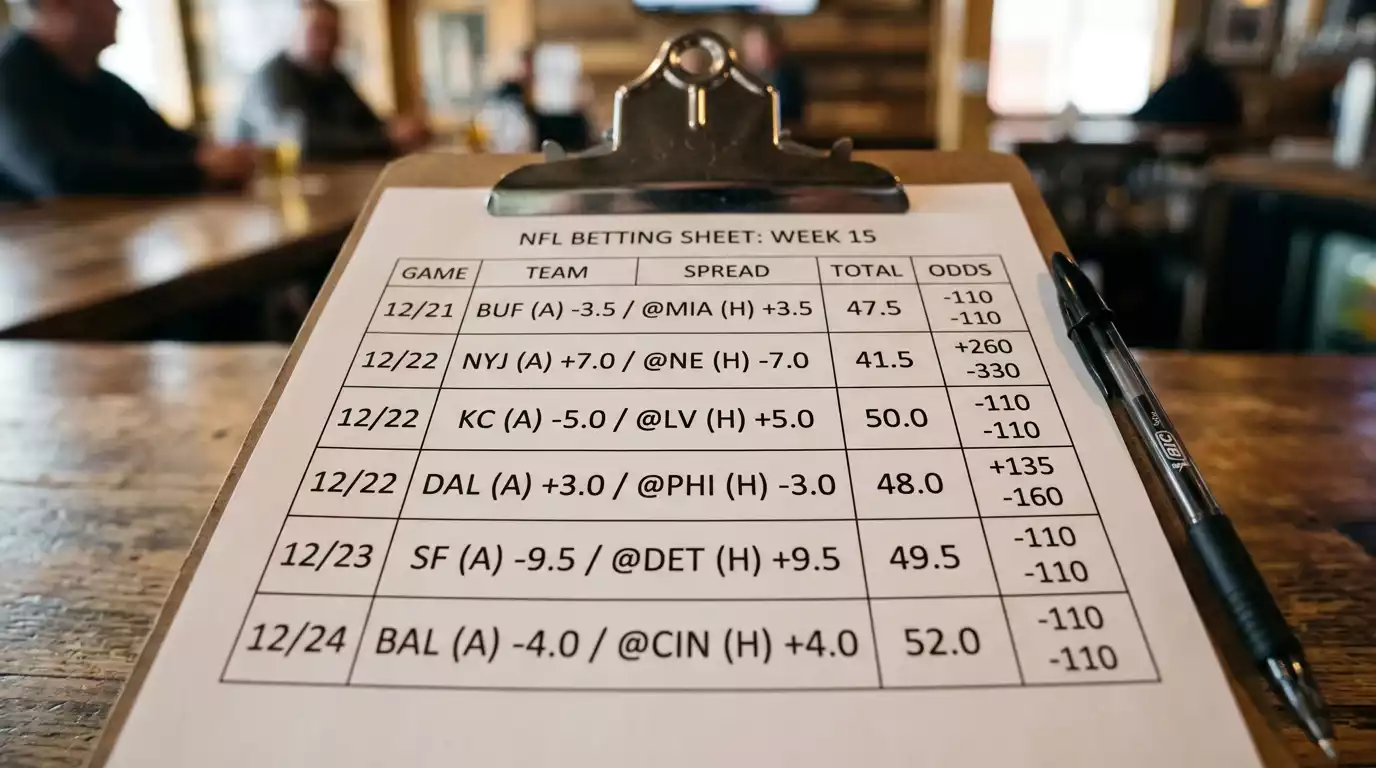
Here’s how to read it. If a sportsbook posts Kansas City Chiefs -6.5 vs Denver Broncos +6.5, the Chiefs are favoured by six and a half points. Back the Chiefs on the spread and they need to win by seven or more for your bet to land. Back the Broncos and they can lose by six or fewer — or win the game outright — and you collect. The half-point eliminates the possibility of a push (a dead heat where stakes are returned), which is why you’ll see .5 on most NFL lines.
What most casual bettors miss is that the spread moves. From the moment an opening line drops — often on a Sunday night for the following week’s games — money flows in from sharp bettors, syndicates, and recreational punters. If the early action hammers the Chiefs at -6.5, the line shifts to -7 or -7.5 to rebalance. Conversely, heavy underdog money pulls the line back toward -6 or -5.5.
Jay Croucher, Trading Director at PointsBet, has noted that a team playing on their home turf typically receives a 1.5-to-2-point advantage baked into the spread, reflecting crowd support, travel fatigue for visitors, and familiarity with the playing surface. That built-in adjustment is invisible to the untrained eye but critical to interpreting any line you see.
The spread also reacts to news. A starting quarterback ruled out on a Friday afternoon can move the line by three to five points within minutes. Weather forecasts calling for 30-mph winds at an outdoor stadium will compress totals and nudge spreads. Injury reports, released by NFL teams on a mandatory Wednesday-Thursday-Friday schedule during the season, are the single biggest catalyst for line movement between the opening number and kick-off.
For UK bettors, this timeline matters. NFL injury reports typically drop between 17:00 and 22:00 GMT, meaning the sharpest line moves happen while you’re still awake. That’s a genuine advantage over American bettors in western time zones who may be commuting or at work when the key information hits.
One more thing worth understanding: the spread is not a prediction of the exact margin. It is a number designed to split opinion and generate roughly equal action on both sides. The sportsbook profits from the margin (the “vig” or “juice”) built into the odds on each side, not from picking winners. When you see a spread, you’re looking at a market-clearing price, not a forecast — and that distinction changes how you should approach every wager.
Key Numbers in NFL Spreads: Why 3, 7, and 10 Matter
Three. Seven. Ten. If you learn nothing else from this entire article, remember those numbers. They are the structural pillars of NFL scoring, and they dictate where the money goes in spread markets more than any other single factor.
Here’s why. In American football, the most common scoring plays are the touchdown (six points, almost always followed by a one-point conversion for seven total) and the field goal (three points). That makes final margins of three and seven disproportionately common. Across the NFL’s 2025 regular season — which drew an average of 18.7 million viewers per game, the highest since 1989 — roughly 15% of all games finished with a margin of exactly three points. Another 9% landed on seven. Those two numbers alone account for nearly a quarter of all results.
Ten is the third key number because it represents a touchdown-plus-field-goal margin (7 + 3), and it appears more often than any other double-digit margin. After ten, the frequency drops sharply — margins of four, five, eight, and nine are all significantly less common than three, seven, or ten.
What does this mean for your betting? It means the difference between a spread of -2.5 and -3.5 is enormous. At -2.5, every game decided by exactly three points is a winner for the favourite. At -3.5, every one of those games is a loser. That single point of movement — one lousy point — flips roughly 15% of outcomes from win to loss.
The same logic applies at seven. A line of -6.5 captures all those seven-point wins; -7.5 misses them. Smart bettors shop for spreads that sit on the right side of these thresholds. If you can get a favourite at -6.5 instead of -7 at one sportsbook, or an underdog at +3.5 instead of +3 at another, you’ve gained a measurable edge over time.
I’ve tracked my own spread bets over the last six seasons, and the pattern is stark. My win rate on bets where I landed on the “good” side of three or seven is roughly eight percentage points higher than on bets where I crossed to the wrong side. Over hundreds of wagers, those eight points are the difference between a profitable season and a losing one.
Some UK sportsbooks offer alternative spreads — adjusted lines at different odds. You might see Kansas City at -3 (10/11) and -7 (11/5) side by side. The alternative lines let you choose your risk profile, but the key-number principle remains: crossing three or seven always costs more in implied probability than any other single-point move.
Here’s a practical framework. When evaluating any NFL spread bet, ask yourself: does this line sit on or near 3, 7, or 10? If yes, which side am I on? If the spread is -3, you’re at the most contested margin in the sport — a coin toss zone where pushes are common and half-point line shops matter enormously. If you can buy down to -2.5, do it. If you can’t, ask whether the juice (the price on the bet) still offers value given the risk of landing exactly on the number.
Reading NFL Spreads at UK Sportsbooks: Fractional and Decimal
The first time I tried to explain NFL spreads to a British bettor who’d spent years on Premier League accumulators, the conversation stalled at the odds format. He was used to seeing 5/1 or 11/4. Now he was looking at something like “Bills -4.5 (10/11)” and couldn’t parse what the 10/11 part meant in relation to the minus sign. If that sounds familiar, this section is for you.
At UK sportsbooks, NFL spreads are displayed with a handicap number and an accompanying set of odds. The handicap is the spread itself — the points advantage or disadvantage applied to the team. The odds represent the price you pay (or receive) for that particular spread. In most cases, both sides of a standard spread are priced at 10/11 in fractional odds (or 1.91 in decimal), which reflects the sportsbook’s built-in margin.
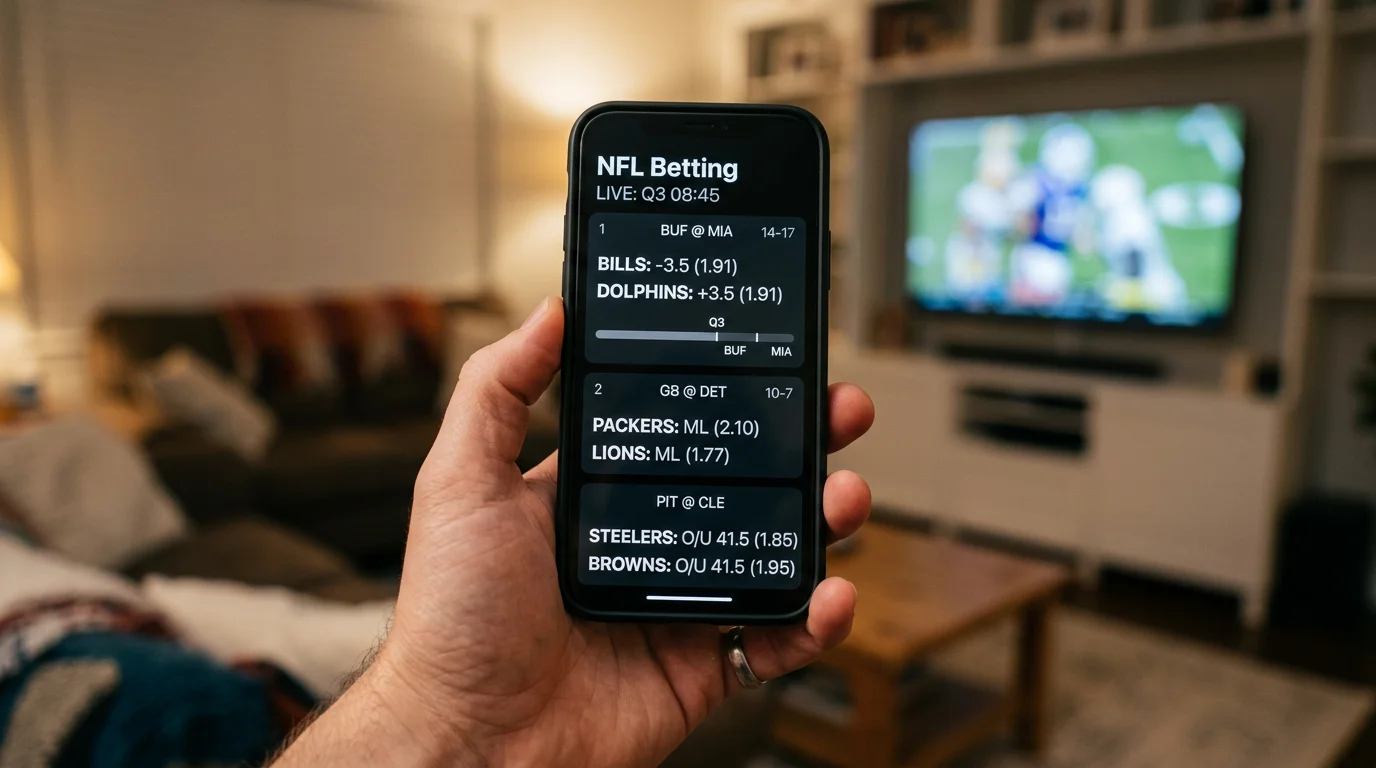
Let’s say you see “Buffalo Bills -4.5 (10/11), Miami Dolphins +4.5 (10/11)”. A ten-pound stake on the Bills at 10/11 returns nineteen pounds and nine pence if they win by five or more — your ten-pound stake plus nine pounds and nine pence profit. The same stake on the Dolphins returns the same amount if the Dolphins lose by four or fewer, or win outright. The sportsbook makes its money from the slight edge built into that 10/11 price on both sides — in a perfectly balanced market, they collect a small margin regardless of the outcome.
In decimal format, the same bet looks like “Bills -4.5 @ 1.91”. A ten-pound bet at 1.91 returns 19.10 — you multiply your stake by the decimal odds to get the total payout, including your original stake. Many UK bettors I work with prefer decimal odds for NFL because the maths are instant: stake times price equals return. No fractions, no mental arithmetic. About 10% of the UK population actively bets on sports online, and the share using decimal format has grown steadily as European and American sports gain traction.
Some sportsbooks also display American odds alongside fractional and decimal, especially on their NFL pages. American odds appear as -110 or +110, indicating how much you need to stake to win a hundred units (negative) or how much you win on a hundred-unit stake (positive). At -110, you stake one hundred and ten pounds to win one hundred. It’s the standard NFL price in the United States, and while UK sportsbooks rarely default to this format, understanding it helps when you’re comparing lines across international platforms.
The critical takeaway: the spread number and the odds are two separate pieces of information. The spread tells you the margin. The odds tell you the price. A spread of -3 at 5/6 is a different bet from -3 at 10/11, even though the handicap is identical. Always check both before placing your wager, because the odds determine your actual return — and the difference between 5/6 and 10/11 adds up across a full NFL season.
Home-Field Advantage and Its Impact on the Spread
There’s a persistent myth among newer NFL bettors that home-field advantage doesn’t matter anymore — that modern athletes travel so comfortably and stadiums are so standardised that location is irrelevant. I’ve heard this argument dozens of times. And every season, the data says otherwise.
Oddsmakers typically build a 1.5-to-2-point advantage into the spread for the home team. If two perfectly evenly matched squads face each other, the home side would be favoured by roughly two points. That number accounts for crowd noise (which disrupts the visiting offence’s snap count), the absence of travel fatigue, and familiarity with the playing surface — particularly relevant at outdoor stadiums where wind patterns and field conditions vary.
The effect isn’t uniform, though. Certain venues produce a larger home-field edge than others. Denver’s altitude (1,600 metres above sea level) measurably affects visiting teams’ conditioning in the fourth quarter. Seattle’s enclosed design amplifies crowd noise to levels that regularly cause false-start penalties on the road offence. Green Bay’s frozen December turf is a nightmare for teams accustomed to domed stadiums. When you see a spread that feels half a point too high, check the venue — it might explain the discrepancy.
For UK punters, the London games add a fascinating wrinkle. The NFL staged a record seven international games in 2025, three of them in London. In these contests, neither team has a true home-field advantage. The designated “home” side doesn’t get the usual 1.5-to-2-point bump because they’re playing 5,000 miles from their own fans in a neutral venue. Some oddsmakers still apply a fractional advantage to the designated home team, but it’s typically closer to half a point than two.
Both squads face transatlantic travel, jet lag, and an unfamiliar playing surface. The team that arrives earlier in the week often adapts better, and historical results from International Series games suggest that teams making the trip from the American East Coast hold a slight edge over West Coast opponents, purely because of the smaller time-zone shift. That’s a situational angle worth tracking.
My rule of thumb: never ignore home-field advantage, but weight it appropriately. A two-point adjustment is the baseline for a neutral matchup at a standard NFL venue. Adjust up for hostile environments (Seattle, Denver, Green Bay in winter) and down for dome teams hosting in climate-controlled comfort. For London games, treat the spread as if neither team is at home — because neither is.
Spread Betting Strategies for the NFL Season
Most strategy articles I’ve read on competitor sites amount to “research the teams and follow expert analysis.” That’s not a strategy. That’s a platitude. Here’s what actually moves the needle when you’re betting NFL spreads from the UK, distilled from nine seasons of tracking every wager I place.
The first and most impactful approach is line shopping around key numbers. I covered why three, seven, and ten matter — now here’s how to exploit them. Open accounts at a minimum of three UKGC-licensed sportsbooks. Before placing any spread bet, compare the line at each. If one shop has the Chiefs at -3 and another has them at -2.5, take the -2.5. The difference in expected value across a season of doing this consistently is significant. You’re not looking for wild discrepancies; half a point at a key number is enough.
Second: bet into early lines. Opening numbers drop on Sunday evenings and Monday mornings (UK time). These early lines are set by oddsmakers’ models before the market has weighed in. Sharp money — the wagers from professional syndicates and experienced bettors — hits these lines first, pushing them toward the “true” number. If you’ve done your homework and have a view that differs from the opener, getting in before the line moves gives you the best price. By Wednesday or Thursday, the spread has already absorbed the sharpest opinions and settled closer to its closing number.
Third: track situational spots. Not all games carry the same emotional or physical context. A team coming off a bye week has had fourteen days to rest, game-plan, and heal injuries — historically, bye-week teams cover the spread at a higher rate than average. A team playing a Thursday night game after a Sunday contest has had just four days of preparation, which correlates with sloppier play and lower scoring. Divisional rematches in the final quarter of the season tend to tighten, because familiarity between coaching staffs compresses the margin of superiority. None of these are guarantees, but they’re tendencies worth factoring into your assessment.
Fourth: monitor live line movement as an information tool even when you’re betting pre-match. In-play wagering now dominates online sports betting, and that real-time flow moves pre-match lines too. If a spread opens at -3 and drifts to -1.5 by Thursday with no injury news to explain it, the market is telling you something — perhaps a key player is dealing with a quiet soft-tissue issue, or perhaps sharp bettors with proprietary data have formed a consensus that the opening line was too high. Use movement as a signal, not a strategy in itself, but treat it as another data point alongside your own analysis.
Fifth: specialise. You cannot follow all 32 teams at the level of depth required to find consistent edges. I focus on six to eight teams each season — enough to track every roster move, coaching tendency, and divisional dynamic, but few enough to develop genuine expertise. Specialisation is the reason I spotted a three-point mispricing on a mid-season divisional game last year that casual bettors scrolled right past. If you’re building a long-term NFL betting strategy, narrowing your focus is more valuable than broadening your action.
One last note: keep your ego out of it. The spread is a market, and markets are efficient more often than not. If your model says the line should be -4 and the market says -7, the market is probably right. Only bet when your edge is clear, quantifiable, and backed by more than a hunch.
Point Spread vs Moneyline: When to Choose Which
A question I get asked constantly: “If I think the Chiefs are going to win, why not just bet the moneyline?” Fair point — and the answer depends entirely on the size of the spread and the corresponding moneyline price.
When the spread is small — say, -1.5 or -2.5 — the moneyline on the favourite is usually reasonable. A -2.5 favourite might be priced around 4/6 on the moneyline, meaning you’re paying a modest premium for the simpler bet: just pick the winner, no margin required. In tight matchups, the moneyline avoids the stress of needing to cover a specific number, and the price difference between the spread bet (at 10/11) and the moneyline (at 4/6) is small enough to justify the switch if you believe the favourite will win but aren’t confident about the margin.
The equation flips when the spread grows. A -10-point favourite might be priced at 1/7 or shorter on the moneyline. Risking seventy pounds to profit ten is a losing game in the long run — one upset wipes out seven successful bets. At wide spreads, the point spread is almost always the better vehicle because it offers near-even-money odds (10/11 on each side) regardless of how lopsided the matchup is. You’re taking on more risk by needing the favourite to win by a specific margin, but you’re compensated with far better pricing.
Underdogs present the inverse scenario. If you like a +7.5 underdog, the spread bet gives you a cushion: they can lose by a touchdown and you still win. The moneyline on the same underdog might be 11/4 or 3/1, which pays more but requires an outright victory. For underdogs you believe can genuinely win (not just keep it close), the moneyline is the higher-variance, higher-reward play. For underdogs you think will compete but ultimately lose, the spread is safer and more consistent.
My personal rule: if the spread is three or fewer, I’ll seriously consider the moneyline on the favourite. Between 3.5 and 6.5, I default to the spread. Above seven, the spread is the only sensible option unless I’m specifically targeting a moneyline underdog upset. It’s not a rigid system, but it keeps me from overpaying for favourites in situations where the spread offers better mathematical value.
Common Spread Betting Mistakes UK Bettors Make
After nearly a decade of analysing NFL spreads, I’ve seen the same errors repeat themselves across thousands of conversations with UK bettors. These aren’t obscure traps — they’re fundamental missteps that erode your bankroll week after week.
The first is ignoring the juice. Two sportsbooks might both list the Chiefs at -3, but one prices it at 10/11 and the other at 5/6. That gap looks small, but over a hundred bets it compounds into a meaningful difference in total return. Always compare the odds attached to the spread, not just the spread itself. Bettors who fixate on the handicap number and ignore the price are leaving money on the table every single week.
The second mistake is chasing steam moves. When a line shifts dramatically — say from -3 to -5 in a few hours — some bettors assume the “smart money” has spoken and pile on at the new number. But by the time the line has moved, the value has already been extracted. The sharp bettors who caused the move got -3; you’re getting -5. Following steam after the fact is buying at the top, not catching a wave.
Third: betting every game. The NFL offers 16 games most Sundays during the regular season, plus Thursday and Monday night fixtures. The temptation to have action on every contest is enormous, especially when you’re watching from your sofa at midnight UK time and want something to care about. Resist it. My most profitable seasons are the ones where I bet four to six games per week, not fourteen. Selectivity is the hallmark of every successful spread bettor I know.
Fourth: overvaluing recent results. A team that won by 30 points last week feels unstoppable, and a team that lost by 30 feels hopeless. The spread already accounts for recent performance — oddsmakers adjust their power ratings after every game. When you add your own recency bias on top of the market’s adjustment, you’re double-counting. Look at the spread as the market’s informed opinion, and only deviate from it when you have a specific, evidence-based reason that the market hasn’t priced in.
And finally: treating the spread as a guarantee of competitiveness. A game with a 14-point spread can still be close, and a game with a 1-point spread can be a blowout. The spread reflects the market’s best estimate of balanced action, but it doesn’t constrain the outcome. Your job as a bettor is to find spots where the price is wrong — where the market has overreacted to narrative, underreacted to data, or failed to account for a situational factor. That’s it. Everything else is entertainment.
Frequently Asked Questions
What is a point spread in NFL betting?
A point spread is a handicap applied to an NFL game to level the betting field between a favourite and an underdog. The favourite must win by more than the spread for a bet on them to pay out, while the underdog can lose by fewer points than the spread (or win outright) and still cover. At UK sportsbooks, a typical spread might look like Chiefs -6.5 / Broncos +6.5, with odds of 10/11 on each side.
What happens if the spread lands exactly on the final margin?
If the spread is a whole number — say -3 — and the favourite wins by exactly three points, the result is called a push. Your stake is returned in full, with no profit and no loss. This is why many NFL spreads use half-point lines like -3.5 or +6.5: to eliminate the possibility of a push and guarantee a decisive result on every bet.
How does home-field advantage affect NFL point spreads?
Oddsmakers typically build a 1.5-to-2-point advantage into the spread for the home team. This reflects crowd noise disrupting the visiting offence, the absence of travel fatigue, and familiarity with the playing surface. The adjustment varies by venue — high-altitude Denver or notoriously loud Seattle may warrant a larger bump, while neutral-site London games reduce the home edge to near zero.
Can I combine spread bets in an accumulator?
Yes, most UK sportsbooks allow you to include NFL spread selections in accumulators (parlays). Each selection must win for the accumulator to pay out, and the combined odds multiply with each added leg. Be aware that combining spreads amplifies risk significantly — a single losing leg voids the entire bet. For a more controlled approach, some bettors use teasers, which adjust the spread in your favour across multiple games at reduced odds.
Created by the ”Betting nfl Games Online” editorial team.